
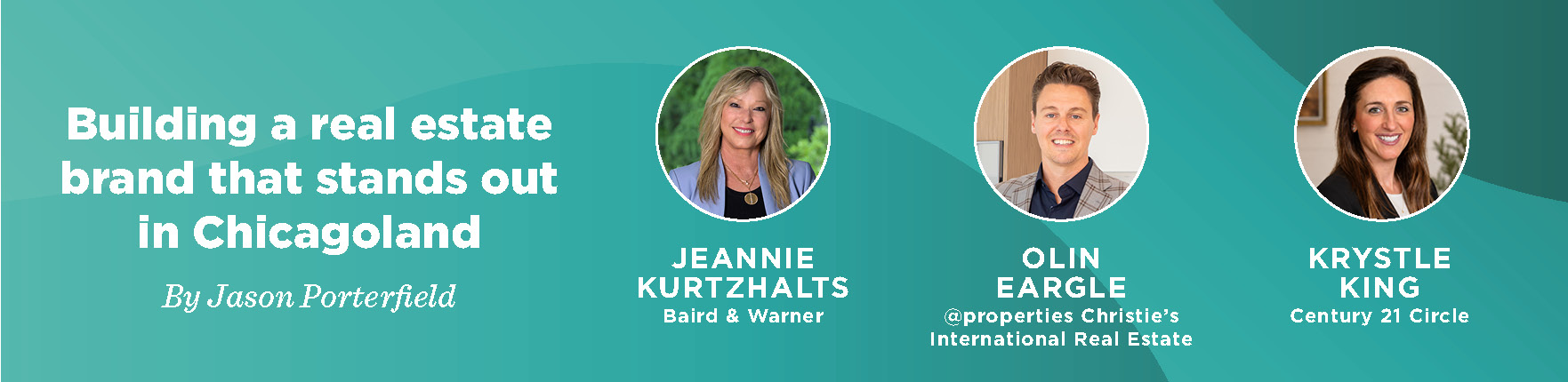
Low supply, high demand and a pool of thousands of agents make the Chicagoland real estate market fiercely competitive. Whether they are developing their personal brands, honing their approach to specific target audiences or finding innovative ways to fold new technology in with tried-and-true methods, agents are adapting to stand out. The challenge is in building an audience while remaining genuine, approachable and trustworthy.
Olin Eargle, a real estate advisor at @properties Christie’s International Real Estate in Chicago, said that the biggest mistake agents make is trying to market a version of themselves that they think people want to hire. Instead, their brand needs to be an extension of themselves and what they can offer.
“There are thousands of real estate agents here in Chicago,” Eargle said. “I’m not going to be able to differentiate myself by just saying, ‘Hey, I’m Olin, and I’m a Realtor and I offer great service and I’m a good negotiator and I know the market.’ Those are things that clients should really expect from any good agent.”
Krystle King, an agent with the Seifert & King Team with Century 21 Circle in Addison, believes that an agent’s brand should reflect who they are as an agent and where they feel confident in their expertise.
“Whether that’s a certain geographic area, price point, property type or type of client, you need to know your market and understand the people you’re serving,” King said. “Knowledge, experience and education are a huge part of building trust.”
Branding and expertise
Jeannie Kurtzhalts, an agent with Baird & Warner in Winnetka, observed that individual agents are becoming better at creating their own personal brands and logos than in the past, but they also have to focus on the client experience. She makes a point of being present at showings and is involved in all the details because she wants every client to feel that their home and their move matter to her personally.
“A strong brand has to be specific enough that people can describe you when you’re not in the room,” Kurtzhalts said. “It isn’t the logo or your colors. Those are pretty and they’re necessary, but it’s the actual experience that people associate with you. For me, that means very personal, hands-on service.”
King emphasizes the importance of agents’ defining their target audience. Once an agent knows their audience, they have a better understanding of their needs, as well as the best way to respond to their questions and the sort of information they will find most valuable.
“It doesn’t mean you can only work with one type of client; it simply helps you be more intentional with your marketing and communication,” King said. “It’s about knowing who you can help, connecting with them and consistently providing value.”
Eargle works across the city and on the North Shore across price points but feels having a defined audience is more important than focusing on a particular area.
“I learned very recently not to pigeonhole myself into a certain neighborhood in a negative way,” he said. “I was briefly named the mayor of a neighborhood just because I worked so much in that area and was so well known there and eventually lost two pieces of business because two people moved out of that neighborhood and to a different neighborhood in Chicago and didn’t call me, and said, ‘Oh, well, I didn’t think you worked there.’ You really have to make sure that clients understand where you work and how broad and vast your area of expertise is.”
Maintaining the sphere
Eargle tries to remain in contact with past and current clients in his sphere at roughly the same proportion. He uses a database and a CRM to keep in touch so that his clients continue to receive information from him, including invitations to events, new listings or market information.
“It’s important to me that I am not a transactional broker,” he said. “Once the deal is closed, my job is not over. The relationship is not over. My clients end up hearing from me consistently during and after they’ve worked with me. I like to think of it as a lifelong partnership.”
Past clients already know how a particular agent works and still want information, Kurtzhalts said. “Depending upon how well you know the person that you’re marketing to, the level of information goes up as the level of the relationship goes down. That doesn’t mean that you don’t provide continual information to your past clients. They want to know their home values and neighborhood values, but you can also do more personal marketing.”
With past clients, King wants to be the first person they call for anything related to their home, even if they’re not thinking of buying or selling.
“With prospects, it’s about providing value, sharing relevant market updates and being a trusted real estate resource without putting pressure on them,” King said. “I want them to know I’m here when the time is right for them. With personal contacts, I think the relationship is naturally more personal. You’re letting them into your life a little more, while also making sure they know you’re active in real estate and are always available to help them or someone they know with their real estate needs.”
Balancing personality and professionalism
Social media makes it easy to blend professional content such as new listings with the type of personal posts that make agents more relatable to past, current and prospective clients. Kurtzhalts primarily uses Instagram and Facebook, where she has an established audience.
“They can be very valuable because you’re reinforcing relationships you already have, and then through those relationships, you’re trying to attract others,” Kurtzhalts said of social media. “I’m posting and getting responses on those platforms to past clients, to people I know, people in my community, and that’s leading to other people noticing and engaging as well.”
Kurtzhalts estimates that about 80% of the posts to her business page are real estate-related, while her personal page has very little business content. Her Instagram account has a mix of both. An animal lover who owns Siberian huskies, she occasionally uses her dogs in photos because they help express who she is as an individual.
Eargle finds Instagram to be the most effective platform for generating business, followed closely by Facebook. YouTube and LinkedIn are secondary. He feels that for a business account, 80% to 90% of the content should be professional, “with some personal and life stuff thrown in.”
Eargle has a social media manager who advises making just three “quality posts” per week, while emphasizing consistency. When it comes to video, she told him always to have a hook and to make his point within seconds.
“People are scrolling quickly, so give good info and something that will make them want to rewatch that video again or share it,” he said. “A mistake that I’ve made a thousand times before I started working with a social media manager was thinking I needed to have 30-second and one-minute and two-minute videos. Today, it’s 7-10 seconds.”
King focuses most of her social media efforts on Facebook and Instagram, while trying to think ahead to the future and what platforms might become dominant.
“When you use social media successfully to build your brand and connect with people, generating business can become a byproduct of those relationships,” King said. “Social media also gives you the opportunity to stay in front of people and remain top of mind. The most effective platform is the one you’re comfortable using and will consistently show up on. You don’t have to be everywhere; you just need to be present and consistent where your audience is.”
Building trust online
Positive online reviews, up-to-date websites and a strong Google presence all contribute to an agent’s appearing professional and trustworthy. Kurtzhalts believes a top agent should have a presence everywhere.
“I’m not so sure that actual leads are coming through websites these days, but people are going to be Googling you,” Kurtzhalts said. “They’re going to be looking at what kind of business you do, what your price point is, where you do it, how often you do it.”
King said those online searches give potential clients their first glimpse of an agent’s reputation, their experience and how they take care of their clients. Neighborhood content helps show that agents know the communities they work in by sharing local knowledge, while positioning them as a trusted resource for the area.
“When potential clients search for an agent online, they should find someone they can trust and feel a connection with before they even make that first call,” King said. “They should see that the agent is professional, knowledgeable about the market and active in the areas they serve. It should also be easy to find their contact information and know how to reach them. Most importantly, they should get a sense of your personality and who you are as a person. Your online presence should give people confidence that you’re someone they would feel comfortable calling, connecting with and ultimately working with.”
For Eargle, a strong online presence makes agents more visible in a crowded professional field.
“Standing out online with a good website, having good reviews and testimonials, anything from past clients, is huge in today’s market for that digital presence and for proving yourself,” he said. “We love having positive client testimonials. Every once in a while you might get a negative review, but you want to make sure that you post all of your good information so that whenever Google or the search engines are looking for it, that’s what they’re finding for you.”
EXPERT SOURCES
Jeannie Kurtzhalts
Baird & Warner
Krystle King
Century 21 Circle
Olin Eargle
@properties Christie’s International Real Estate