
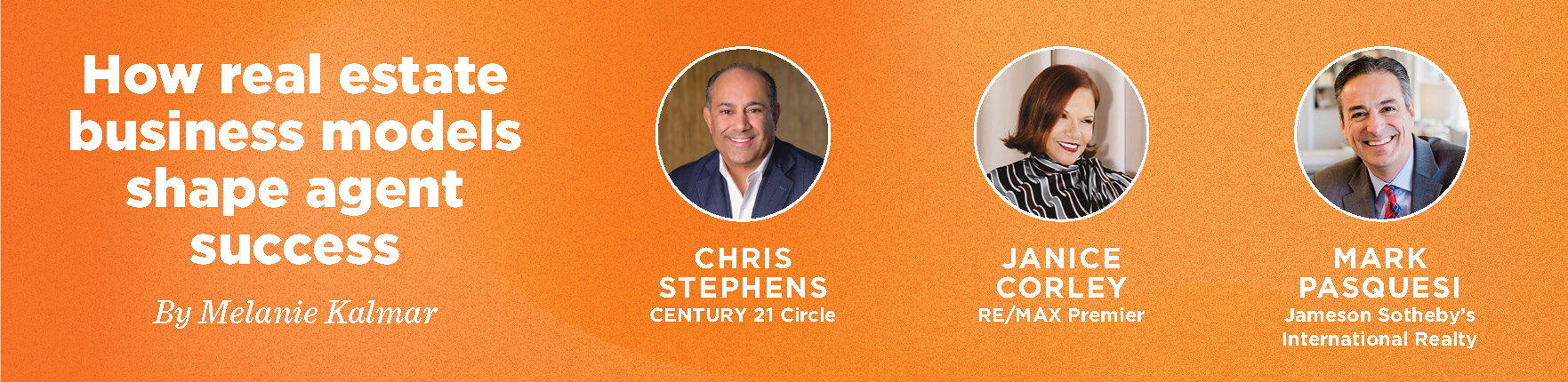
A variety of brokerage structures — traditional, teams, boutique, online and fee-based — exist for a reason: Every agent has different priorities they consider necessary to reach optimal performance levels.
In a competitive and ever-evolving marketplace, how real estate companies operate matters to agents and the clients they guide through one of life’s biggest financial decisions. Support systems, branding, technology and culture vary across business models, differences that impact agent productivity, recruitment and retention — making finding the right fit a crucial business decision.
Traditional full-service brokerages offer high-level support on the back end, freeing up agents to do what they do best: build relationships with clients and prospects that eventually lead to sales. Teams provide mentoring of newer agents and dependable partners to fill in during vacations. Boutiques deliver personal service inherent in a small-sized brokerage, while online and fee-based brokerages offer higher pay structures without administrative and operational support.
Essentially, agents are choosing where to work based on value — training, lead generation, collaboration and long-term growth opportunities — factors that provide insight into what’s driving success in today’s real estate landscape. Chicago Agent recently spoke to industry leaders about what makes the design of their business models effective and how they’re adapting to shifting market conditions.
Common Chicagoland business models
A renaissance of sorts is happening in the industry, according to Chris Stephens, vice president of agent development and coaching/commercial team leader at CENTURY 21 Circle. Agents that gave online brokerages a try only to become disenfranchised with virtual training and coaching are joining traditional full-service brokerages like CENTURY 21 Circle for access to those services in real life. Plus, CENTURY 21 Circle’s managing brokers offer advice based on real-world experiences, because they are out there selling too — something some managing brokers haven’t done in years. For those reasons, the “pendulum has swung,” Stephens said. He added that online models are beginning to purchase traditional brick-and-mortar companies to provide the support that agents desire.
“Agents today want more than a license, office space and transactional oversight,” Stephens said. “They are evaluating commission structure and the full ecosystem surrounding them: leadership access, coaching, operational support, marketing, technology, collaboration, culture and long-term business scalability. The most successful brokerages are transitioning from transactional environments into business-growth platforms.”
In fact, Stephens joined CENTURY 21 Circle in fall 2025 to fill the need for in-house business development and coaching, services the brokerage previously outsourced.
At RE/MAX Premier, the hybrid business model supports agents who work mostly from home, Janice Corley, CEO and founder of RE/MAX Premier in Chicagoland, said. Agents visit the main RE/MAX Premier office weekly for training and development classes and meet every Thursday via Zoom to discuss “hot topics” in the marketplace. Corley noted that a large roster of agents does not require many offices, but for the sake of convenience, it’s important for brokerages to put all support services under one roof.
The RE/MAX Premier hybrid model offers conveniences, such as a deposit card for Chase bank, so agents can deposit earnest money checks without having to visit the office. Golf outings, happy hours hosted in different markets, movie nights and document shredding events for clients help foster comradery and ease the loneliness agents might occasionally feel working remotely.
Compared to competitors that exceed 1,000 to 3,000 agents, Jameson Sotheby’s International Realty in Lake Forest has 485 advisors/agents on board, enabling it to provide the personal service luxury clients expect, according to Mark Pasquesi, president of real estate services and designated managing broker for the boutique brokerage.
With flat-fee, cap and cloud-based models, Pasquesi said, agents run their businesses entirely. They get a larger percentage of revenue, but they don’t have marketing, administrative or operational support, and that can be an issue. “Agents should be focusing on building and cultivating relationships that drive more business, not finding a layout or brochure for their next listing or making copies of listing sheets,” Pasquesi said.
Nonetheless, he thinks there’s room for all business models in the marketplace because everyone has different preferences, he said. But most top-producing agents affiliate with traditional, full-service brokerages for the high-level support they offer.
Teams versus independent agent models
Newer agents lean toward teams for mentorship, operational support, accountability, leads, collaboration and fast-track growth, Stephens said. But the trade-off is less autonomy, and that can stall careers.
Corley advises new agents to start out on their own, with the help of coaching and classes, to learn how to develop their own business, rather than relying on a team to mostly do it for them and risk delaying their growth. If they still can’t make it after giving it their best shot, then she recommends they try a team model. However, a major downside of joining a team is that production is recorded in the MLS under the team leader’s name, not the agent’s. “The problem is, when competing against another agent for a listing appointment, they don’t have any production under their name,” Corley said. “They don’t get credit for their work.” It’s a fact that puts them at a disadvantage.
Still, that’s not always the case, Stephens asserted. Team structures vary greatly. Smaller teams of two might record production separately in the MLS and appear together in advertisements, Stephens said. Larger teams might operate collaboratively, with each member having clearly defined roles, and other teams more loosely, with agents operating more independently under a shared brand and support system. He advises agents to evaluate both the immediate opportunity and how the structure supports their long-term business growth, personal brand development and future scalability.
“Both paths can absolutely be successful,” he said, noting that independent agents prefer controlling the entire process versus having team members step in at various times to manage everything from showings to negotiations. “The key is choosing the environment that best aligns with how an agent wants to operate, grow and build their long-term business.” Indeed, he noted that experienced agents typically prefer independence over a team, especially since they have already built proven systems, personal brands and referral networks
Before joining a team, Corley said, agents should negotiate what they need to be successful in preparation for the day they exit, including:
- Split on the business they generate versus split on the business they received from the team’s lead agent.
- How their transactions will be reported in the MLS — they should at least get credit for the business they generate.
- Exit fee if they terminate their agreement with the team.
- Key differentiators between brokerages.
- Before committing to a brokerage, aside from commission splits and brand recognition, Stephens said, ask yourself the following questions to determine if it’s a good fit:
- Will this environment help me grow long-term?
- Is leadership invested in agent development?
- Is there real operational and marketing support behind the scenes?
- Does the company evolve with changing market conditions and consumer behavior?
Why branding, culture and leadership matter
Newer agents seek brokerages with the infrastructure and resources to develop their careers, and experienced agents want those same things to overcome plateaus, tackle market shifts and continue scaling their businesses, Stephens said. The brokerages standing out right now deliver on the promises they make during the recruitment process and provide support for every aspect of the business.
Pasquesi said brokerages can communicate value to agents by showing them how the coaching, training, operational support, administrative support and brand positioning can help their business grow. In addition, a brokerage’s best recruitment tool is when its staff and agents communicate value and a positive company culture via their interactions with other agents in the community.
Corley advises brokerages to use the same strategies to retain agents as they do to attract them — or it can backfire. Agents offered a sign-on bonus in exchange for staying with the brokerage for a set time, for example, may leave once it’s up if they didn’t receive the support that was promised.
“Most agents want their business to develop, and most agents don’t really need to be told how to list and sell real estate,” Corley said. “But they do need someone that can help them expand their business in some way to another level.” The only way to do it is to talk to them and understand what they want to do, she said, and try to help them get there.
Agents prioritize support, flexibility and earning potential
Commission structure is important, but a higher split or model that appears to offer the most money upfront rarely tells the entire story, Stephens cautioned. Agents need to evaluate what they are receiving in return. For instance, there can be higher costs for highly independent models, where agents are responsible for doing back-end tasks like producing marketing materials on their own.
“The stronger the infrastructure operationally and in-office, the more time agents can spend focusing on client relationships and revenue-generating activities,” Stephens noted. “Operational support is becoming less of a perk and more of an expectation.”
Hybrid models gain momentum
Hybrid models are increasing in popularity because they allow companies to adapt support structures based on different agent needs, business styles and experience levels, Stephens said. Thus, they cater both to agents that want high support and collaboration and to agents that prioritize autonomy and flexibility.
Realistically, cloud-based models save money on brick-and-mortar offices and rent, Pasquesi noted, but only time will tell what model is truly best.
“Cloud-based companies nationally have recruited the most agents in the past year and at the same time lost the most agents,” he said. “Certain companies only focus on who’s walking in the front door, and not on who’s leaving.”
For best results, brokerages need to focus on attracting talent that’s best suited for the model they offer, he said. And talent should plan to stay long-term to position themselves well for the future.
“Anytime an agent leaves a company to go to different company, they always lose business,” Corley explained. In terms of social media marketing, they must start over and create a new brand, which takes time.
“Go with a company you intend to work with your entire career,” she advised. “Choose the one that provides an opportunity for growth. Name recognition, management support and technology leave no reason to go anywhere else.”
To overcome market shifts and economic pressure, brokerages need to identify their differentiator, Pasquesi added. Jameson Sotheby’s is operating as a boutique luxury full-service firm. “At the end of the day,” he said, “the right brokerage or team should not simply help agents close transactions. It should help them build a stronger long-term business and career.”
Expert sources
Janice Corley
RE/MAX Premier
Mark Pasquesi
Jameson Sotheby’s International Realty in Lake Forest
Chris Stephens
CENTURY 21 Circle