
Take a close look at highly desirable, established neighborhoods that have priced out the masses. Now take a closer look at the areas adjacent to them, to show buyers that they can live close by in an affordably priced home and still enjoy the other neighborhood’s upscale amenities. All the better in a property poised for growth, given its location, desirable schools, investment activity and access to public transportation and infrastructure that makes getting to and from work easy.
Neighborhoods in proximity to upscale, popular areas, dubbed “emerging markets,” are proving to be a remedy for the lack of affordability holding back today’s buyers.
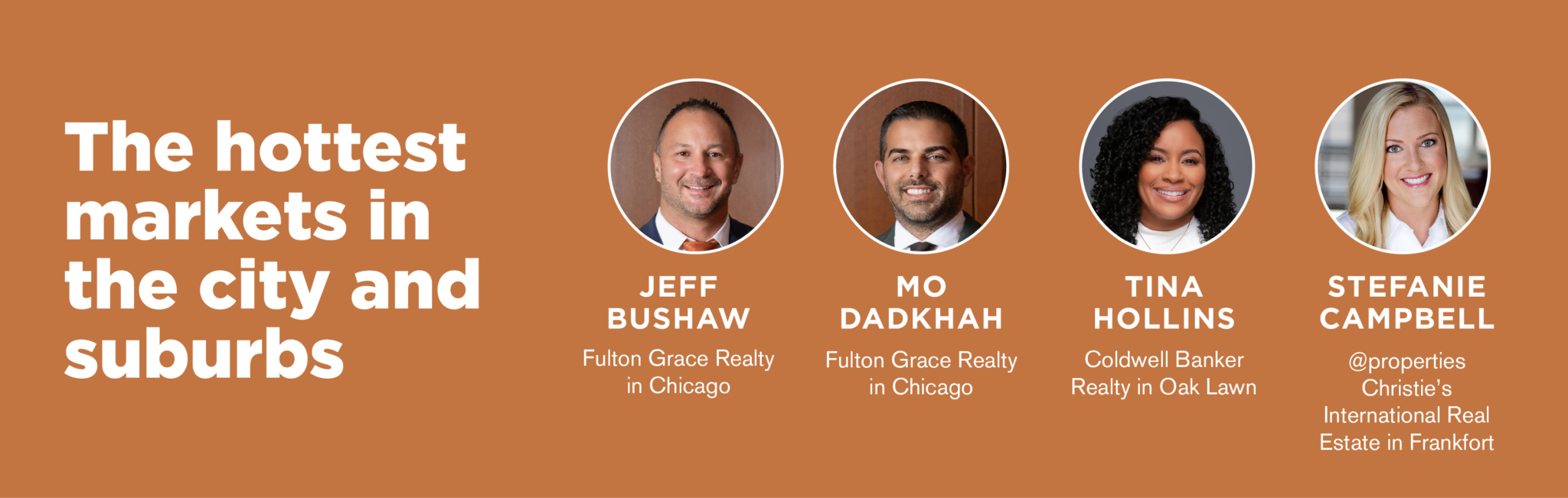
How do you find these hidden gems? Easily. The key indicators of an emerging market are young families establishing roots; new restaurants, bars, coffee shops and boutiques popping up; and increasing school ratings, according to Jeff Bushaw, a broker with Fulton Grace Realty in Chicago.
“An emerging neighborhood is a neighborhood where we’re seeing a shift happen before it hits the mainstream headlines,” Bushaw says. “It’s where prices are still lower than the neighboring, more expensive community.”
What is driving interest in emerging neighborhoods? “Oftentimes these fringe neighborhoods have a sharper rise in value,” says Mo Dadkhah, a broker with Fulton Grace Realty who works with Bushaw, and the CEO of Dadkhah Law Group. “As they become more popular, more buyers move into those areas, and anytime you have more buyers than sellers, you see an increase in property values. But you are primed for larger appreciation than you would probably get in the nicer, more established neighborhoods, because you bought at a slightly lower price-point.”
When Tina Hollins, a luxury property specialist with Coldwell Banker Realty in Oak Lawn, spots a mix of affordability, accessibility and investment, it signals an emerging market. “You’ll see businesses moving in, improvements in transit access and infrastructure, and people getting to major employment hubs more easily,” Hollins explains.
Buyer behavior is another clear indicator. “When you see buyers priced out of established neighborhoods and starting to look a mile or two over, developers typically follow those buyers,” she says. “They bring in new housing, and it shifts the area’s profile.”
In addition, new parks and schools or neighborhood organizations advocating for improvements, as well as residents’ putting more resources into the area, usually means appreciation is on the horizon.
Fueling interest in those areas is a mix of affordability, access and lifestyle, Hollins says. “Buyers who are priced out of fully established neighborhoods are looking for value and finding it in the neighborhood that still offers character and space, but at a more approachable entry point. You can be a little closer to the neighborhood and almost pay half the sticker price.”
Be on the lookout for construction. Development is a huge driver of emerging areas. “When you start to see builders reinvesting in the housing stock and retailers opening doors, it signals stability and growth,” Hollins says. “Transit improvements in proximity to major employment hubs adds another layer of appeal for buyers looking for shorter commutes and better connectivity. And, of course, the lifestyle and culture factors. Buyers are drawn to walkable community parks, restaurants, coffee shops, green spaces and schools for young families who want to establish roots.”
All those factors come together to create momentum. “Affordability gets people looking,” Hollins says. “Lifestyle keeps them interested, and investment secures long-term growth. Buyers see the value increasing in these neighborhoods and say, ‘This is where I can be for the long haul.’”
Must-see emerging neighborhoods
In the northwestern suburbs, Wheeling and Mount Prospect are emerging and close to the popular suburbs of Glenview, Northbrook, Buffalo Grove and Deerfield, Bushaw says. Palatine and Schaumburg are hotter than ever before, and Prospect Heights and Rolling Meadows are fringe areas gaining in popularity.
“The suburbs are hot right now,” Dadkhah explains. “Families that would make a second move in the city and wait until their kids are school-age to move to the suburbs are going to the suburbs earlier, because they can buy a single-family home for the cost of a condominium in the city.”
Beyond the numbers, it comes down to lifestyle, Bushaw adds. “Families are looking for yards, extra bedrooms, safer streets and top-rated school districts. The rise of remote and hybrid work accelerates the shift.” On top of that, the luxury condominium market downtown is seeing price drops and softer demand, he notes, while suburban homes have continued to appreciate.
“Price opens the door,” Bushaw says. “But space, lifestyle, schools and shifting market momentum are what’s really pushing younger families into the suburbs faster than before.”
Bushaw calls Wheaton a standout for walkability, great schools, parks, community events and easy access to Metra and the Eisenhower expressway. Best of all, starter homes cost between $400,000 and $500,000.
Head to south-suburban Frankfort for walkability to a variety of trendy restaurants, glorious nature trails and a quaint downtown akin to adorable Hallmark movie settings. “The lifestyle is a huge draw: concerts in the green, surrounded by restaurants and local stores,” says Stefanie Campbell, a Realtor and partner at The Gold Group with @properties Christie’s International Real Estate in Frankfort. Outdoor enthusiasts will become enamored with Old Plank Road Trail, a 22-mile walking and biking trail that runs through the downtown area, connects various subdivisions and extends to Joliet and New Lenox.
With a population exceeding 21,000 residents, Frankfort attracts former Chicago residents because there is always something to do, Campbell says, and the lifestyle is similar. “The highly rated schools and sense of community are the biggest sellers,” she says. Frankfort’s Fall Fest, featuring daily concerts, local vendors, shops, artists, businesses and a children’s carnival, attracts 250,000 visitors annually. The community is also home to Prestwick Country Club, offering golf, pickleball, swimming, tennis and other recreational activities.
As of July of this year, the average price of a single-family home in Frankfort was $559,802, up from $297,694 in January 2015.
“A lot of people make it their goal to live within walking distance to downtown Frankfort,” Campbell says, noting that it’s the mentality of those relocating from Chicago to the suburbs. “When an event is going on, they want to be able to walk out the front door and go to it instead of looking for parking.”
Continued development of homes and the growth of businesses and restaurants make Frankfort an emerging market.
“The village is very picky,” Campbell says. “They make sure any business or building they put into the community makes sense and would add value for residents.”
Campbell says her passion for Frankfort, her hometown since 2012, likely stems from the fact that she grew up in Grant Park, a small town about 35 minutes south. “The community togetherness is just like none other,” she says. “Everyone really has each other’s backs. It is a small-town feel.”
Hollins can relate. Born and raised on the South Side of Chicago, she can easily pinpoint the hot areas of the city, because she watched the neighborhoods change and gentrify.
Bronzeville has a magnetic pull because it combines cultural identity with modern housing, Hollins says. It is a historic neighborhood undergoing significant revival, backed by a couple of city initiatives like INVEST South/West and the multibillion-dollar Bronzeville Lakefront development. These revitalization efforts are bringing more affordable prices on historic greystones and new construction for investors.
South Shore is gaining traction because of its lakefront living, its historic housing and the anticipated Obama Presidential Center, which is also driving interest in Woodlawn, Hollins says. And McKinley Park has been drawing young professionals “priced out” of Pilsen. “Compared to more expensive nearby neighborhoods like Pilsen, South Shore has long offered relatively affordable housing options, making it a port of entry for new Chicagoans,” she says. “Recent data shows that in McKinley Park, median sales prices are seeing double-digit sales percentages increasing year over year.”
Topping Bushaw’s list of emerging neighborhoods in the city, in terms of property values and new developments, are Avondale and Jefferson Park.
Avondale has a good restaurant scene, he says, and is still averaging about $500,000 to $550,000 for a single-family unit. “Inventory has been flying in Avondale,” Bushaw adds. “Demand is very hot. There is still a gap between the pricier neighborhoods nearby — Old Irving Park, Irving Park and North Center are very expensive.”
Jefferson Park is convenient for commuters, with the CTA’s Blue Line and Metra, and the convergence of the Edens and Kennedy expressways. “Homes are averaging sub-$500,000 but still appreciating,” Bushaw says. “You’re getting a solid mix of more single-family homes with multifamily units, and there’s still room to build equity.”
Investor opportunities
Years ago, people called the east side of Humboldt Park “West Bucktown” when it started to gain traction, Bushaw said. It is cheaper than Logan Square and has a rich Puerto Rican heritage and unique food scene. And in West Humboldt Park, he says, there’s still room for investment appreciation.
“Investors are getting more cash flow right now because rents are rising faster than property prices in Avondale, Jefferson Park, Humboldt Park, South Woodlawn and Little Village,” Bushaw says. “And when those returns become obvious, more buyers compete for the same buildings, which drives up values and boosts resale profits.”
In the suburbs, Round Lake and Round Lake Beach are more reasonably priced than surrounding Grayslake and Lake Villa, Bushaw says, and are close to the Fox Chain O’ Lakes for people who enjoy lake life.
“Anytime you have neighborhoods that are nearby more popular areas, they’re primed for a higher rate of appreciation because they’re starting at a lower price point,” Dadkhah says. “In the city of Chicago, we saw it with Pilson 10 years ago. Property value rose sharply. It is near transportation, close to the most sought-after neighborhoods in Chicago, has a great rental market already built into it and the price point grew rapidly. As rental rates go up and prices don’t follow as sharply, the return on investment for multifamily buyers becomes nicer.”
Savvy investors should watch the northwest side of Chicago, particularly Jefferson Park. Stable tenants, great schools and easy transit make properties very rentable. Plus, it is surrounded by more expensive neighborhoods, Bushaw says. “Humboldt Park and West Humboldt Park still have appreciation upside, because they’re undervalued compared to Logan Square and Wicker Park.”
Anchored by the University of Chicago, Hyde Park has a consistent stream of rental demand from students, academics and the nearby hospital, Hollins explains. On top of that, its cultural history and stability make it a reliable choice for residents.
South Shore is also primed for appreciation because of its lake access, historic architecture and development potential, as well as for attracting buyers priced out of more expensive lakefront areas. “Investors who are patient can find historic homes ripe for renovation and long-term value,” Hollins says. “The area’s lower property costs and unique amenities attract those looking for an alternative to expensive North Side lakefront properties.”
Englewood has seen a recent surge of development that is certain to capture investors’ attention, Hollins says. She points specifically to the Englewood Connect project (a redevelopment of an historic firehouse into a business incubator and community space) and the Thrive Exchange (a new, mixed-use development that includes affordable housing). “Investors can look into multifamily buildings and commercial properties tied to new development corridors,” she says. “Most of the area is an opportunity zone that offers major tax benefits for investors.”
In the South Loop, massive redevelopment projects are increasing real estate values and transitioning the neighborhood from industrial to a vibrant residential and cultural hub, Hollins says. It offers a prime location near downtown, stunning lakefront access and a wide mix of housing, amenities and attractions, such as McCormick Place and Wintrust Arena.
“As someone who grew up on the South side, I don’t just watch these neighborhoods change,” Hollins says. “I live them, and my role is to help clients see the opportunities before they become obvious.”
Overall, when you compare Chicagoland as a market to any other big city across the country — Los Angeles, New York, Miami, Austin or Denver — it is still a bargain, Dadkhah says. “Property values are very attractive. You can still get so much more home for the money.”
Expert Sources
Jeff Bushaw
Fulton Grace Realty in Chicago
Mo Dadkhah
Fulton Grace Realty in Chicago
Tina Hollins
Coldwell Banker Realty in Oak Lawn
Stefanie Campbell
The Gold Group with @properties Christie’s International Real Estate in Frankfort.