
As 2026 begins, Chicago’s housing market is often framed through the lens of caution. Interest rates remain elevated. Inventory is beginning to loosen. Buyers and sellers are adjusting expectations after several volatile years. That context matters. But it is incomplete.
When you step back from month-to-month market noise and look at the underlying economic data, a clearer picture emerges. Chicago’s fundamentals remain durable. For real estate professionals, that distinction is critical. Housing demand ultimately follows jobs, investment and confidence in a region’s future.
At a recent market outlook hosted by the Chicago Association of Realtors, I shared the indicators we track closely at World Business Chicago. The takeaway was straightforward. Chicago’s economy is performing better than its reputation suggests, and that performance has direct implications for housing in 2026 and beyond.
Corporate investment continues to choose Chicago
For 12 consecutive years, Chicago has ranked first among U.S. metros for corporate relocations and expansions, according to Site Selection magazine. This ranking reflects real decisions by companies placing long-term bets on the region.
Those decisions are driven by structural advantages. Chicago sits at the center of North America’s trade corridors. O’Hare International Airport remains one of the world’s busiest hubs for both passengers and freight. The region is home to the nation’s largest inland port. Just as important, Chicago’s economy is broadly diversified. No single industry accounts for more than 13% of total employment.
For housing markets, this diversity matters. It reduces exposure to single-sector downturns and creates a steadier pipeline of households entering the market across price points and neighborhoods.
A labor market that sustains demand
Chicago’s workforce continues to be one of the city’s strongest assets. The region has approximately 5.5 million working-age residents. Each year, roughly 140,000 graduates enter the local labor market, placing Chicago among the largest talent pipelines in the country.
This steady inflow supports household formation and anchors long-term demand. Increasingly, Chicago functions as a “college town at scale,” drawing students from across the Midwest and beyond who choose to stay, work and buy homes after graduation. For agents, that translates into continuity rather than boom-and-bust cycles.
Billions in active development are reshaping the city
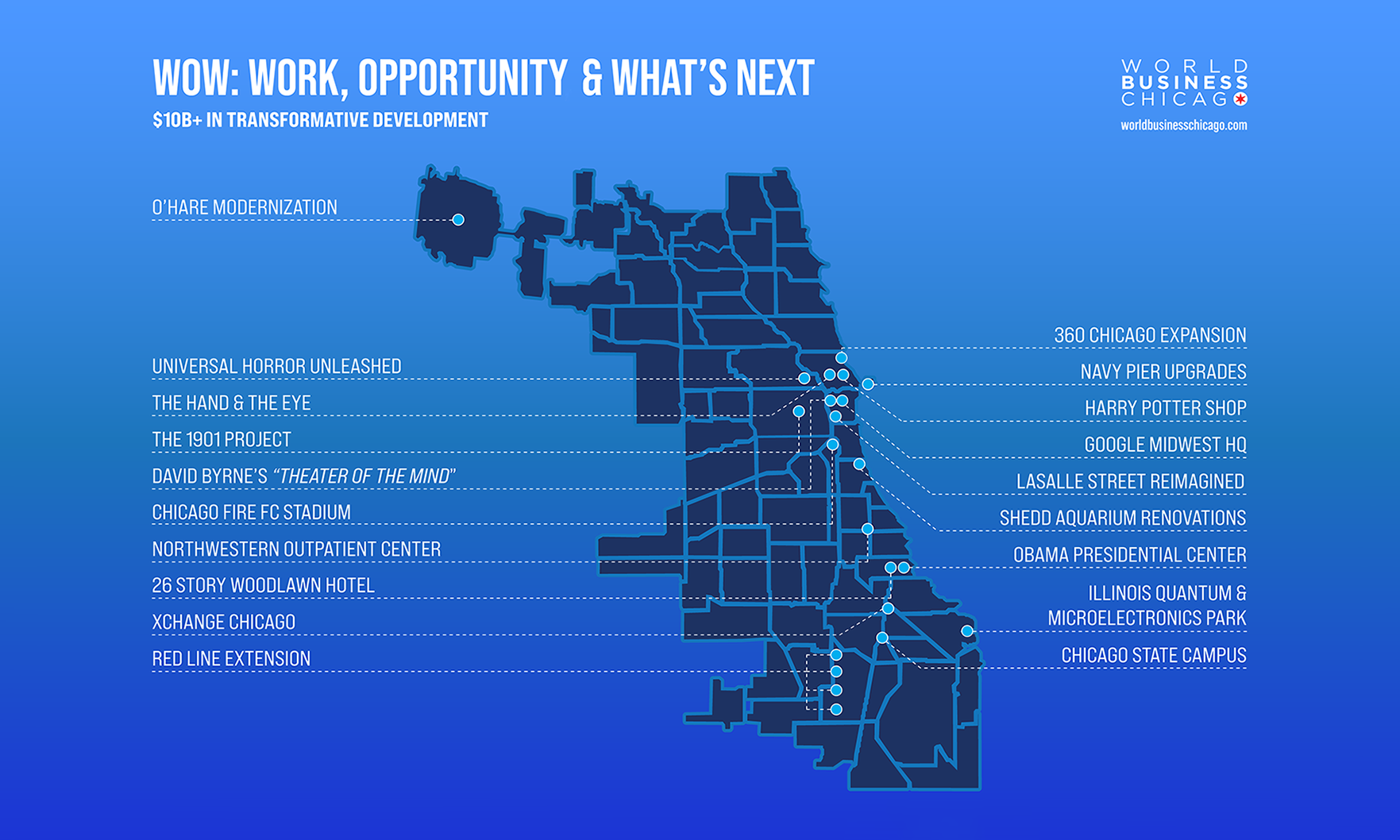
More than $18 billion in major projects are currently underway across Chicago. These include the Obama Presidential Center, Google’s redevelopment of the Thompson Center into its Midwest headquarters, Northwestern Medicine hospital expansions, the 78 redevelopment along the South Branch of the Chicago River, and Universal’s first indoor theme park near Halsted Street and Chicago Avenue.
Each project carries different timelines and market effects. Collectively, they generate construction employment in the near term and reshape neighborhood demand over the long term. Large-scale cultural, institutional and entertainment investments also signal confidence that extends well beyond any single market cycle.
Public safety trends are moving in the right direction
Public safety remains a concern for buyers and sellers alike. Here, too, the data is improving. Last year, Chicago recorded its safest summer since 1965, with notable declines in shootings and carjackings. These outcomes reflect coordinated efforts across city agencies, community organizations, business leaders and philanthropy.
Buyers pay attention to trends, not anecdotes. As conditions improve, perception follows — often with a lag, but it does follow.
A long-term growth strategy is in place
Last year, we released Chicago 2050, a long-range plan developed with hundreds of leaders from business, labor, government and community organizations. The plan focuses on sectors where Chicago has competitive advantages, including advanced computing, artificial intelligence, life sciences, climate technology, advanced manufacturing, logistics and financial services.
Importantly, it also recognizes arts, culture, food, sports and entertainment as economic drivers, not side benefits. Recent global entertainment investments reinforce that shift.
What this means for 2026
The national housing picture remains mixed. Chicago’s is more grounded. Strong employment fundamentals, diversified industry growth, improving public safety and sustained investment point to a market defined by resilience rather than volatility.
For brokers working with cautious buyers or skeptical sellers, the message is clear. Chicago’s economic foundation is stronger than the prevailing narrative suggests. The data supports that conclusion.
I look forward to continuing this quarterly conversation. In the meantime, readers can visit worldbusinesschicago.com to download the “Chicago 2050” playbook and explore the data behind the strategy. One simple economic gauge reinforces the story. Chicago issued 18 crane permits for 2025, with seven cranes currently standing across the city, a visible signal that long-term investment remains active as this market moves forward.
Phil Clement is the President and CEO of World Business Chicago.