
The U.S. housing market is expected to see slower home price growth in 2026, but a persistent shortage of homes continues to shape market conditions, according to new reports from Realtor.com and Zillow.
Realtor.com’s 2026 Forecast Midyear Update report projects that home price growth will cool further, with prices expected to increase 1.2% for the year, compared with its previous December forecast of a 2.2% increase.
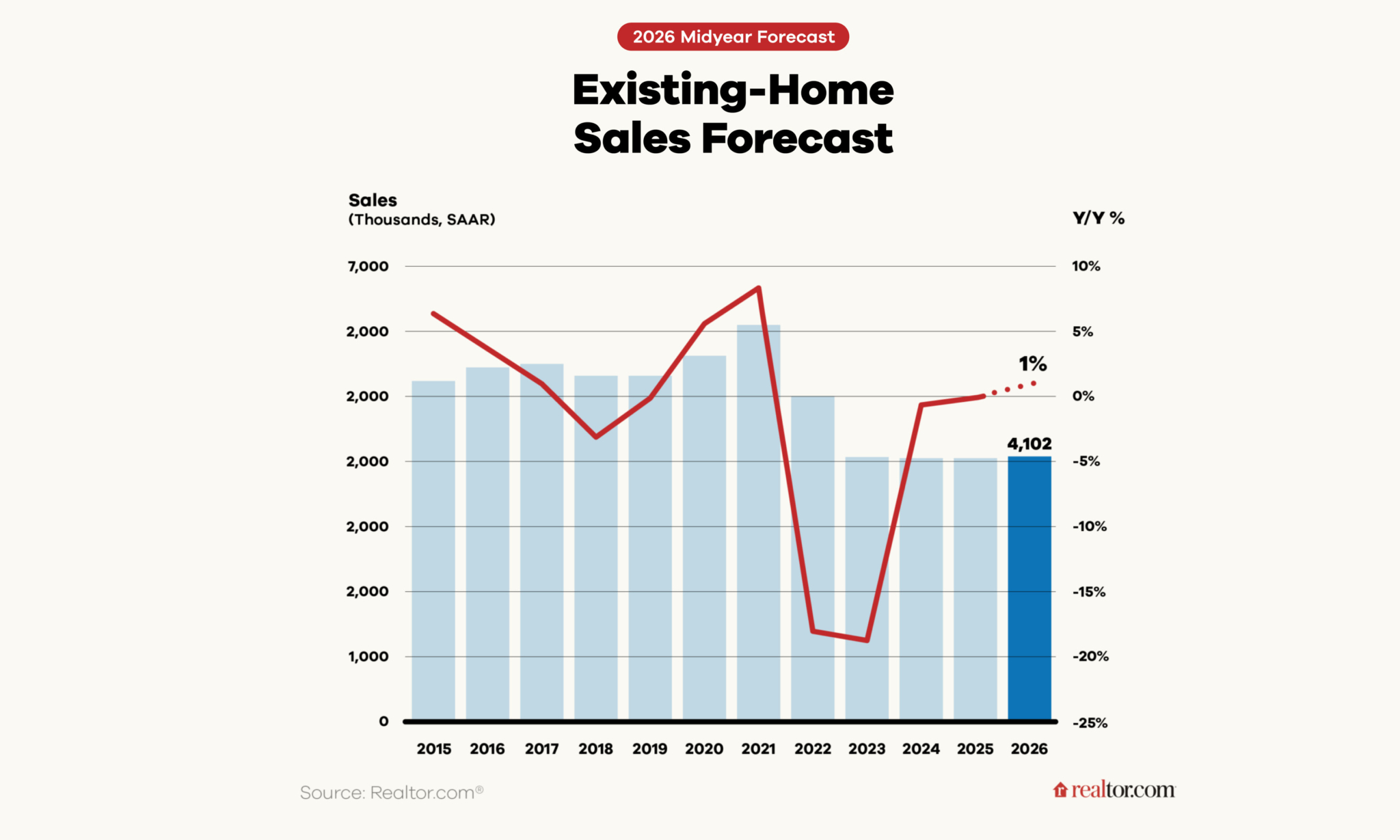
Existing-home sales are expected to reach 4.10 million in 2026, representing 1.0% year-over-year growth. The updated projection compares with the company’s previous December forecast of 4.13 million existing-home sales and 1.7% annual growth.
“Against a backdrop of both familiar and new challenges, the economy has proved resilient. As a result, the first half of 2026 delivered stability more than momentum in the housing market,” said Danielle Hale, chief economist at Realtor.com. “The housing market is inching forward as sellers reset expectations, price growth cools and buyers gain more negotiating power. Looking ahead, we expect momentum to build through the second half of the year as more sidelined buyers and sellers find terms that work for both sides.”
Realtor.com also revised its outlook for existing-home inventory growth. The company now expects for-sale inventory to increase 3.6% year over year in 2026, down from its December forecast of an 8.9% increase.
At the same time, Zillow’s latest housing deficit report, based on data from the U.S. Census Bureau, found that the country’s housing shortage remains substantial.
In the Chicago metropolitan area, Zillow estimated a housing deficit of 115,282 homes in 2024, an increase of 8,760 homes compared with the previous year.
Chicago also had a larger share of affordable for-sale listings compared with many major markets. In the Chicago metro area, 47.4% of listings were affordable in May 2026, up from 46.7% in May 2025.
According to Zillow, the United States had a housing deficit of 4.7 million homes in 2024, an increase of 43,438 homes from the previous year. The increase was significantly smaller than in prior years, when the deficit grew by 257,000 homes in 2022 and 159,000 homes in 2023.
Orphe Divounguy, senior economist at Zillow, said, “Behind every missing home is a family doubling up, unable to find or afford a place of their own. Stopping the bleeding is progress, but making a real dent requires more than the status quo.”
In a separate report released by Zillow, there were more than 300,000 empty lots 5 acres or smaller that were listed for sale on its website in June. If one home were built on each of those lots, this reportedly would bring the housing deficit down to roughly 4.44 million homes, a 6.3% reduction from 4.7 million.
Zillow found that the average lot for sale is 0.57 acres, meaning some properties could potentially support more than one home. That makes the 6.3% reduction a conservative estimate.
In Illinois, 6,670 empty lots were listed for sale in June, accounting for 22.3% of all empty lot listings. The median lot size was 0.43 acres, with a median price of $49,900.
The states with the highest number of empty lots listed for sale in June were Florida, with 42,598 listings; Texas, with 40,907; California, with 18,504; North Carolina, with 14,230; and Georgia, with 10,336.
In addition, rural markets unsurprisingly have the highest concentration of vacant land, with empty lots accounting for 25.3% of all for-sale listings. By comparison, vacant lots make up 13.6% of listings in suburban areas and just 9% in urban markets.
Zillow points to these vacant lots as one of the most immediate opportunities to expand housing supply and help address the shortage that has contributed to America’s ongoing affordability challenges.