
Courtesy of the Cook County Treasurer.
Chicago homeowners are reeling from a sense of sticker shock after receiving their tax-year 2024 property tax bills.
The median residential tax bill jumped 16.7%, marking the largest increase in at least 30 years, according to Cook County Treasurer Maria Pappas, who blamed the hike on a dramatic decline in the value of commercial property in Chicago’s Loop following the pandemic.
The amount of taxes imposed on these properties fell by $129 million thanks to falling property values, while residential taxes across the city jumped $469.4 million. The long-awaited tax bills come after Chicago was reassessed in 2024, which triggered the shift in tax burden from commercial properties onto other types of real estate as overall taxes in the city grew by $528.6 million, or 6.3%.
The residential hike was driven by a surge in home values, a $500 million increase in requests from Chicago schools and local governments and the zero-sum nature of Chicago’s tax structure: When one group of property owners (Loop commercial owners) pays a smaller share of the overall tax bill, other groups (homeowners in particular) pay more, Pappas explained.
“When the Loop gets a cold, the rest of the city gets pneumonia,” Pappas said in a release. “Homeowners across the city are paying the price. I’m particularly concerned how lower-income homeowners in struggling communities are going to be able to pay their bills.”
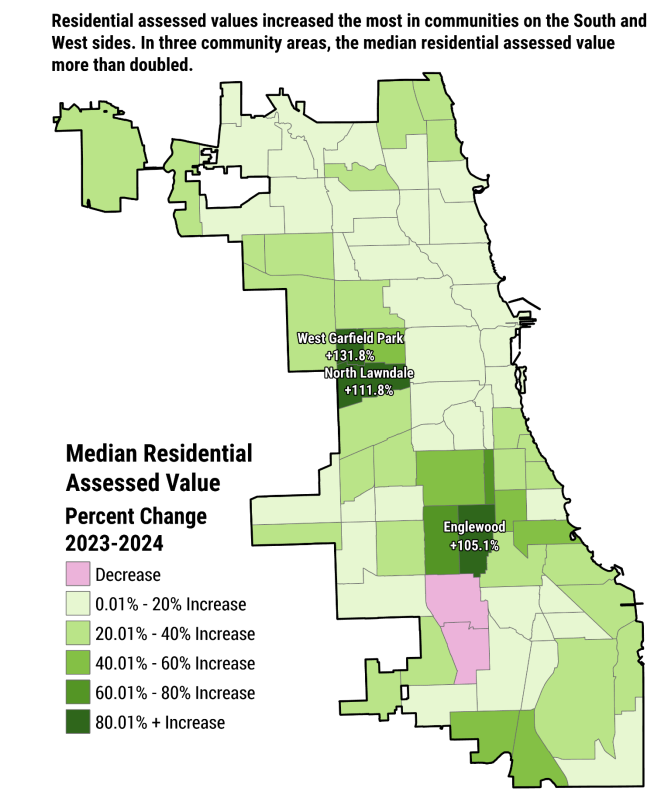
Indeed, the hardest hit Chicago homeowners live in poorer, predominantly Black neighborhoods on Chicago’s South and West sides, Pappas said, noting that nine communities saw their median bills rise over 50%, and three topped 80%: Englewood ($609 or 82.5%), North Lawndale ($1,900 or 99%) and West Garfield Park ($2,000 or 133%).
Courtesy of the Cook County Treasurer.
The jump in city taxes marks the third year in a row in which a reassessed area of Cook County saw a record increase in the median residential tax bill, due largely to declining commercial property values. The southern and southwestern suburbs saw their median bill jump 19.9% to $6,117 in 2024, and the northern and northwestern suburbs saw a median increase of 15.7% to $7,008 in 2023.
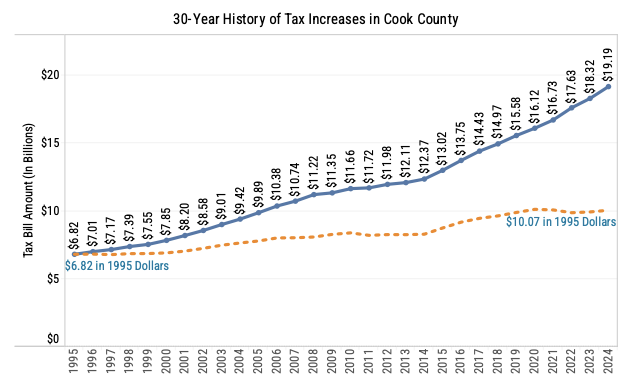
For all of Cook County, property taxes rose $871.8 million, or 4.8%, to $19.2 billion, which was “well above” the 2024 inflation rate of 3.5%, Pappas noted.
Illinois REALTORS® CEO Jeff Baker decried the increase and said Cook County has been relying on property taxes to fund its budget for too long.
“As we have said repeatedly: the real estate tax funding well has run dry,” he said in a statement.
Baker said county government should take steps to ease the burden on homeowners by consolidating and eliminating municipal taxing districts, limiting the reliance on real estate taxes to fund pensions, passing a “meaningful” property tax limitation law and significantly reducing municipal budgets.
Taxes are due Dec. 15.