
Courtesy of the National Association of REALTORS®.
Homebuyers are increasingly interested in green home features when house hunting, although the driver behind the increased attention to sustainability is more likely to come from a desire to save money than to save the planet, a study finds.
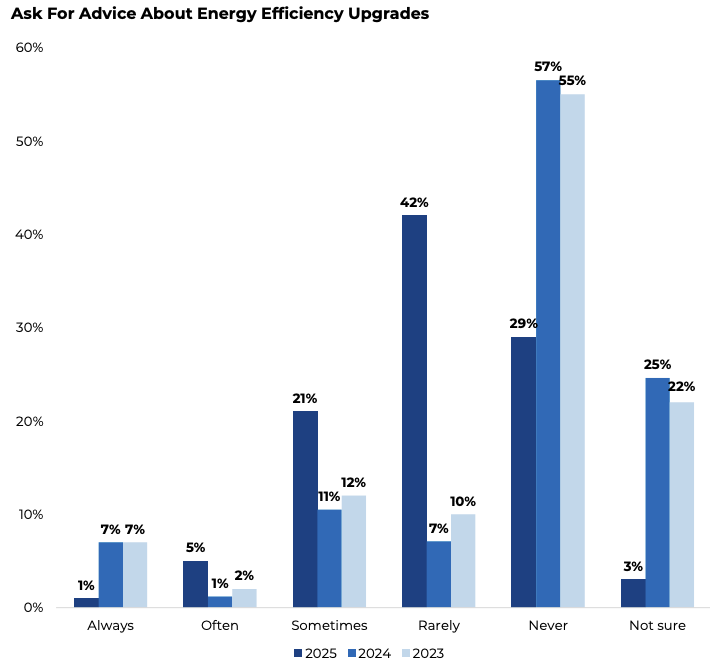
Twenty-seven percent of real estate agents surveyed by the National Association of REALTORS® in April said clients ask them about energy-efficiency upgrades, up from 19% in 2024, while 29% said clients never ask about them, and 42% said they rarely ask about them, compared to 57% and 7%, respectfully, according to NAR’s annual Residential Sustainability Report.
“After a period of time being a GREEN Realtor designee with little client interest in solar panels, tankless water heaters or smart home features, I was delighted to see a strong uptick in each of these the past few years,” EXIT Strategy Realty Founder and CEO Nick Libert said. “I credit part of this to the rapid adoption of [electric vehicles] in our area as a gateway to the other green and sustainable ideas.”
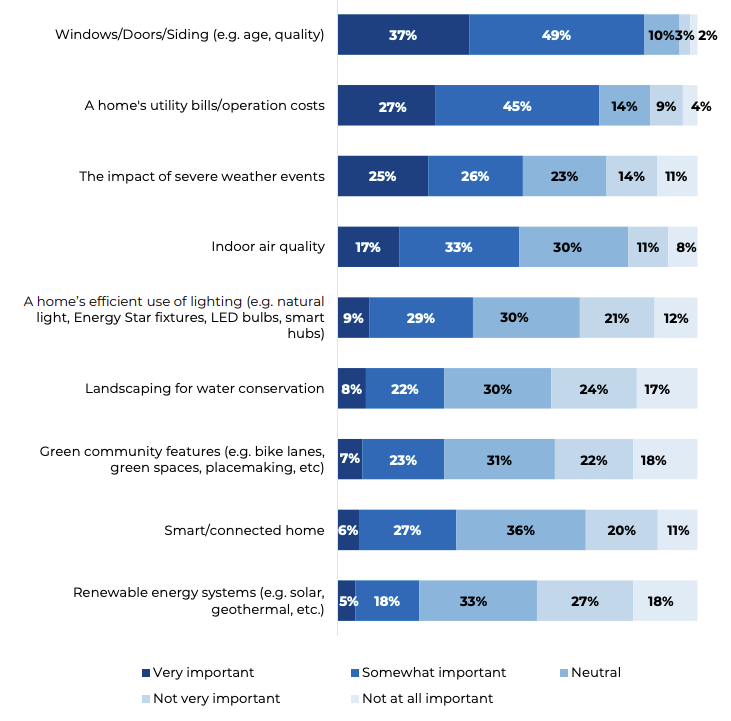
Among the green features most prioritized by clients, windows, doors and siding topped the list, with 37% of Realtors saying their clients said they’re very important, and 49% saying they’re somewhat important, followed by a home’s utility bills and operation costs at 27% and 49%, respectively. Green community features and renewable energy systems like solar panels or geothermal power were among the least important features, according to the respondents.
Courtesy of the National Association of REALTORS®.
“The main items of interest we are seeing are energy efficiency, close or convenient proximity to public transit, and smart-home tech,” Vesta Preferred Realty Managing Broker/Co-Owner Grigory Pekarsky said. “Transit is always a big plus for clients.”
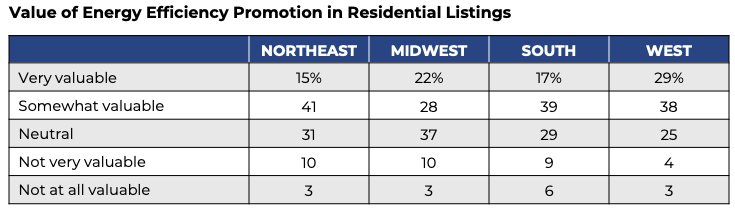
Regionally, energy-efficiency promotion in residential listings is considered very valuable by 22% of the NAR survey’s respondents from the Midwest and somewhat valuable by 28%. Westerners appear to value it the most, with 29% saying it’s very valuable and 38% saying it’s somewhat valuable. In the South, 17% of Realtors called it very valuable and 39% said it’s somewhat valuable, while those numbers were 15% and 41%, respectively, in the Northeast.
Putting a value on a home’s green features is clearly a challenge, according to the report. Seventy-three percent of respondents said they are not sure if their local appraisers are educated about the value sustainability features add to a home, and only 17% said they are educated. Fifty-six percent of Realtors said they are not sure if appraisers assign additional value to sustainable features when appraising a home, while only 6% said they regularly include sustainability in their valuations.
Courtesy of the National Association of REALTORS®.
Engel & Völkers Chicago Private Office Advisor and License Partner Jennifer Ames said that in her experience, Chicago homeowners and homebuyers are less interested in sustainability than in other parts of the country.
“If adding energy features costs more when building, most homeowners will invest in other upgrades,” she said. “On the resale side, I have found that potential buyers find solar panels intimidating and question what may be necessary for future maintenance.”
Indeed, solar panels appear to be a complicated issue for the NAR survey’s respondents. Understanding how solar panels impact a transaction was the top challenge or consideration related to sustainability among agents, with 58% of Realtors citing it, followed by valuation of solar panels on homes, which was cited by 52%, and understanding lending options for energy upgrades or solar installations, cited by 42%.
In another question, 48% of respondents said having solar panels actually makes it more difficult to sell a home, while 32% of them said it does not.
“In Chicago, the focus is more on energy efficiency than solar panels,” RE/MAX Premier Broker Mike Opyd said.
Most survey respondents said economic incentives like tax credits and rebates are the best way to increase demand for sustainable building (47%), followed by higher resale value for sustainable homes (31%), energy cost savings (30%), greater consumer awareness of the health and lifestyle benefits of green upgrades (18%) and greater availability of insurance and climate risk data (17%).
While the availability of green MLS data is increasing, it’s not necessarily being used by real estate agents. Forty-four percent of those surveyed said their MLS includes green data fields, but 47% of those with access to the data do not use it.
Realtors are not encountering green properties particularly often, the survey found, with a plurality of respondents, 31%, saying they rarely work with homes with sustainability elements, followed by 22% who work with them “every few months or so” and 20% working with them once or twice a year or so. The muted market for green homes is only expected to grow, however, as the demographics of homebuyers changes, Opyd predicted.
“As the younger generation of buyers (millennials and Gen Z) enters the market, they are not only focused on finding a property that meets their needs but also their values and beliefs tied to the health of our planet,” Opyd said. “More and more buyers want to live in homes built with sustainable materials, feature appliances that are environmentally friendly and contribute to a healthy planet.”
Interesting findings! It’s promising to see growing interest in green homes, even if the progress is gradual. As awareness increases, sustainable living will definitely become a priority for more buyers.
I definitely agree with Prasanthi’s comment above, we are on a trajectory to seeing more consumers willing to pay a premium for green and sustainable smart home features knowing that they will save money in the long run and have a value add / equity addition to their asset list when they go to sell their property.