
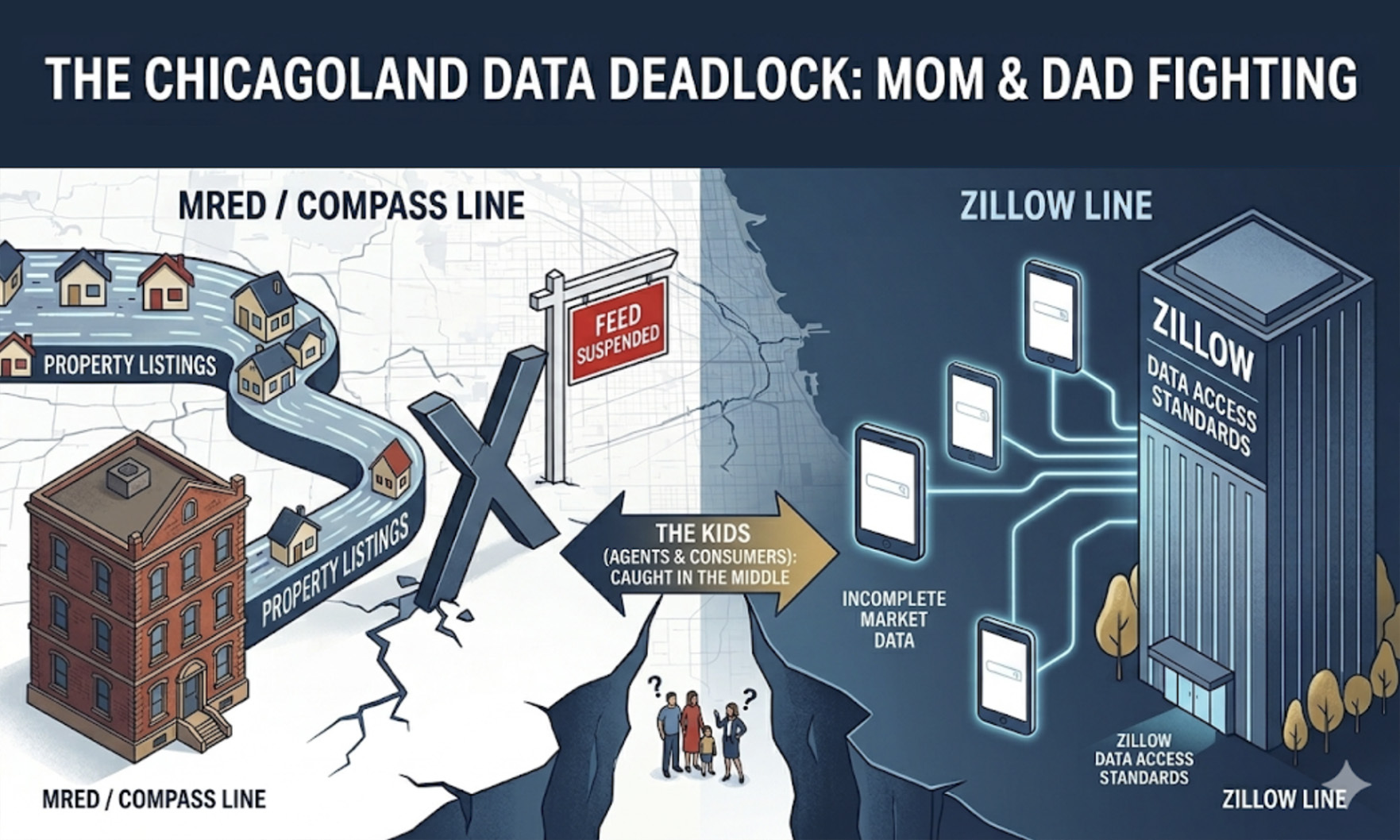
On May 20, the Chicagoland housing market experienced a digital earthquake. Following a complex data licensing dispute and a subsequent federal lawsuit, Midwest Real Estate Data (MRED) officially suspended its listing feed to Zillow. Almost overnight, roughly 43,000 local properties vanished from the internet’s most widely used consumer search portal.
A view from the fault line
To understand this crisis, I have to be entirely transparent about where I stand: I am a Compass agent, but I also maintain a deep, highly successful relationship with Zillow as a partner. I don’t have the luxury of sitting in a detached corporate boardroom choosing a side. Every single day, my business relies on both ecosystems. I use the cutting-edge tools and exclusive inventory provided by Compass, and I simultaneously utilize the massive consumer reach and lead flow generated by Zillow. I love both platforms.
But right now, watching them pull the market apart feels exactly like watching a messy, toxic corporate divorce; and the agents, buyers and sellers are the kids caught in the crossfire.
Mom, Dad, and the custody battle
In this industry split, both parents are operating on deeply held, logical business paradigms. Both somehow correct.
On one side, you have the institutional broker network and the MLS — let’s call them “Mom.” Mom is rules-oriented, protective of the household data asset and demands that every participant play by an identical set of local rules.
On the other side, you have the national tech platform Zillow — lets call them “Dad.” Dad is flashy, user-friendly and controls the massive consumer audience. Dad believes in total data fluidity and objects to any friction that restricts listing visibility. He also has the best toys (LEADS).
Both arguments make perfect sense inside an executive boardroom. The problem is that houses aren’t sold in boardrooms; they are sold on local Chicago streets. While Mom locks the front door and Dad cuts off the allowance, the clients are sitting on the stairs watching the living room furniture get thrown out onto the lawn.
The casualties on the ground
This data disruption impacts every layer of a real estate transaction:
- For sellers: Homeowners do not track macro-level antitrust litigation. They expect maximum exposure for their primary financial asset. Waking up to find their property missing from the country’s largest portal introduces immediate, unnecessary anxiety.
- For buyers: The public search experience is officially fragmented. Navigating an incomplete local real estate inventory makes finding a home in a tight market feel like solving a puzzle with missing pieces.
- For agents: Working professionals are forced to handle the fallout, managing frustrated clients while trying to maintain pipeline momentum without the seamless syndication tools they have relied on for a decade.
What do the kids do? Focus on the client, not the courtroom
My opinion is simple: Stop waiting for Mom and Dad to fix it, and stop letting corporate standoffs dictate your value. Taking a hard line for one corporate flag over the other is a distraction. My only job is to plant my flag in your front yard. Our fiduciary duty is not to tech platforms or national brokerage strategies, it is to the human beings who trust us to guide them through the housing market.
When the digital channels break down, the human advisor becomes the ultimate anchor.
This standoff is a powerful reminder that our true value proposition has never been about hitting a “syndicate” button. It is about work ethic, hyper-local market intelligence and deep personal and agent databases. Buyers still need to find homes, and sellers still need to move.
While the tech giants resolve their differences in a federal courtroom, the agents, buyers and sellers who win this market will be the ones who bypass the corporate noise, pick up the phone and rely on the human connection: the only resource that remains the stable, definitive gatekeeper of Chicago real estate.
ai slop