
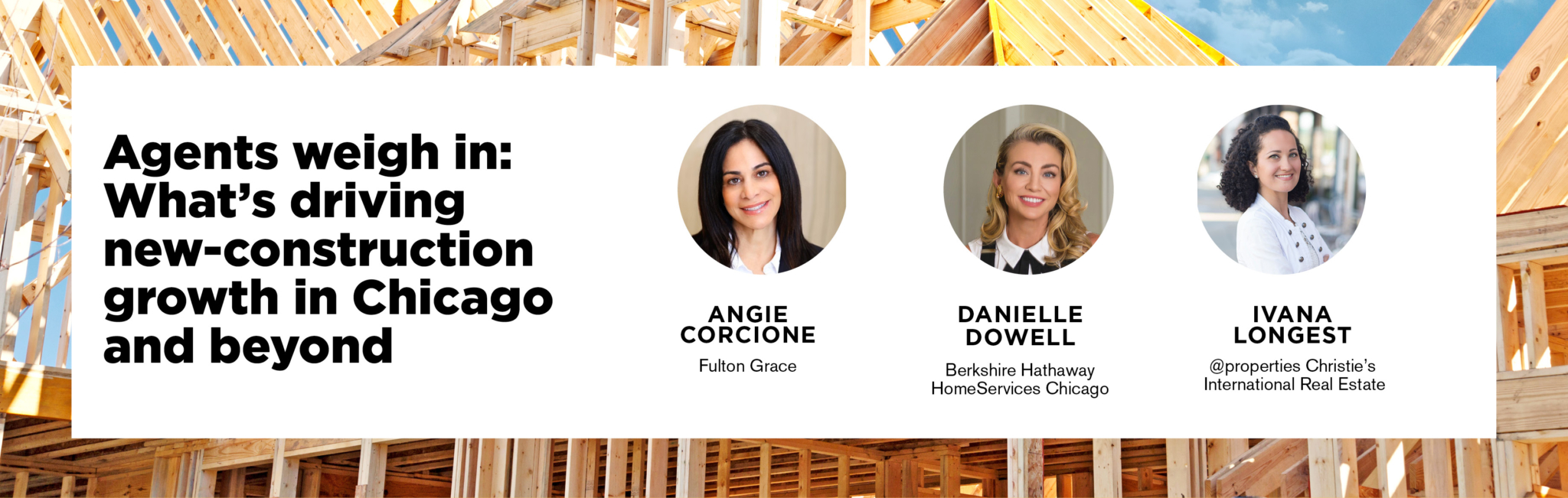
The new-construction market continues to evolve in response to interest rates, shifting buyer preferences and development challenges.
“I think development is great in a lot of suburbs, in a lot of areas and pretty much anywhere,” said Danielle Dowell of the DoWell Group/Berkshire Hathaway HomeServices Chicago. “To be honest, we could use more development. There’s just not enough of it. I think a lot of developers left during COVID and went to other states to develop, and we’re starting to see some of them come back.”
Dowell sees a lack of new construction in the city in general. “Development went a lot to big, multifamily projects, because honestly, it’s easier for developers,” she said. “It makes more sense because the trends have been to rent a little bit longer … more people are renting. In general, it’s kind of more of a European thing. The development you do see in Chicago isn’t so much a ton of confidence and a ton of single families. It’s more like multifamily. And we do some of that, too.”
Ivana Longest of @properties Christie’s International Real Estate has her office in Wilmington and works primarily in southern Will County, an area she described as very active and sought-after due to growth in industry and manufacturing in the area.
“We are very affordable when you look at housing, and not just the type of houses, but also when families are looking at school districts, or somebody’s looking to downsize or somebody wants to get outside,” Longest said. “Outside of Wilmington, New Lenox is a very big area for building and desirability for the schools, and just what they’re doing for the town itself. Frankfort is still getting a lot of traction for new construction. Certain pockets of Joliet are still getting good new construction. Channahon is still getting some new construction for developments, as is Norris. There’s quite a bit of new construction in these pockets of where we’re located.”
Longest recently teamed with a builder on a project to build more ranch-style homes in the area, though that type of home is more costly to build. “That is the one product that’s lacking in our area,” she said. “Even in the neighboring communities, it seems like they want to still do balloon-framing two-story, because it’s cheaper, smaller footprints and not a whole lot of customizing. You have a handful of options, either you pick this package or that package for trim line, and that’s it. We pretty much geared toward figuring out mostly ranch plans and how we can offer semi-custom builds so they have many more finishes that can really make the house their own.”
Angie Corcione, managing broker at Fulton Grace in Elmhurst, is seeing a lot of new construction in the northwestern suburbs, though it depends on price range.
“Of your upcoming areas, such as Lake in the Hills and Hampshire, are your more average price points — let’s call it for $550,000 to $600,000, you can go with new construction,” Corcione said. “At the higher end, like Elmhurst and Glen Ellyn, you can’t touch these areas. In Northbrook overall, you’re starting to see a little bit more new construction in the past couple years from some of your bigger-name developers like Pulte, MIS, D.R. Horton. You’re starting to see it in various areas depending on price ranges, but you’re starting to see more of it overall.”
Pricing and incentives
Corcione feels that homebuyers are becoming accustomed to higher sticker prices on new construction as inflation and rising labor costs have set in.
“When some of that started taking effect two or three years ago, consumers really got a sticker shock,” Corcione said. “A house that may have cost $700,000 to build is now $775,000. I think now that has set in and it’s kind of the norm. This is how material is; this is what the labor costs are. You would think interest rates are a negative with new construction, but they really haven’t been.”
People would rather get into the home now than pay more next year hoping that these rates will come down, Corcione explained. “A lot of new construction will offer special rates if you’re working with a lender. There are certain buydown programs that they can offer, and there are some incentives with new construction. As an agent, sometimes pushing that is beneficial to the client, because you might be spending a little bit more, but overall, your payment is going to be less because of the rate buydown that you’re getting.”
A lot of what is being built in the city now is finished package, according to Dowell.
“Within reason, if you’re on a regular sized lot in the middle of Chicago doing a single family, there’s only so much architecturally that you can do, right?” Dowell said. “I think it’s finished package and thinking of different things that would fit in home with the same floor plans that are upgrades that people would really like. A lot of it too in Chicago really depends on location.”
The market has risen so high in Chicago that increased costs are not affecting new construction in the city “that much,” Dowell said.
“Even though you’re paying more for some of the construction costs and you’re paying more for land, you’re still getting more for the buildings at the end result,” Dowell said. “In a way, it’s kind of balanced itself out. Right after COVID or during COVID, it was really hard because things were just out of stock and prices had skyrocketed. But even though they’re higher, and they’re going to continue to get higher because of inflation, some of that stuff is not nearly as high as what it was, or it wasn’t even high. It was just the unavailability. Being able to get it was hard, and you had to spend more money.”
Longest called interest rates “kind of a buzzkill,” noting that three of the recent builds her team has handled were on a cash basis.
“They’re either pulling out from other investments or they have other options, so they don’t have to worry about it, or it’s a temporary borrow from a retirement account,” Longest said. “However they’re doing it, once they sell their home and after they move into the ranch, they just pay back whatever they have to, so there’s a little more creativity there.”
Building trust
Gaining the trust of builders means agents need to show that they know how new-construction works, from zoning to the build timeline, and from marketing to pricing. Dowell initially started out as an assistant to an agent in Missouri who worked in new development. Later, Dowell and her brother built and sold their own developments. When she came to Chicago, she drew on that background.
“New construction is kind of a different beast,” she said. “You need to understand zoning, lot size, finish packages and all of these different things. As an agent, I feel like if you’re going to do new construction, it’s a lot of different qualities and things that a typical, regular resale agent may not have knowledge of or may not ever come across. I think a developer wants someone that’s really skilled and understands not only just how to sell a property, but how to develop a property, build the property and what the stages are of that, because it’s really important to know those items in order for you to be able to sell the property correctly.”
Longest started out working for her father, who was a developer. She highlighted local knowledge and experience in development as the most important qualities developers look for in agents.
“Knowing your price points, how fast everything’s turning over, what’s missing in price points for housing, and then, obviously, the build process,” Longest said. “When you’re fielding questions from buyers that are kicking around the idea of new construction, there are certain questions that they’ll ask — ‘Oh, can we do this, or can we do that?’ — within the capacities of what’s allowed with what the builder wants to do.”
Agents working new construction will need to be able to tell their clients whether customization is allowed and what can or can’t be done, Longest explained. They’ll have to be aware of the big items on the must-have lists of the buyer pool, from garages to open-concept design. Then it’s a matter of marketing know-how and communicating with the builder.
“You have to know how to market this type of product,” Longest said. “And then just being a good guide and giving some forecasts to the builder. Lots of communication and feedback on what’s happening in the marketplace, just so that there are no surprises coming abruptly from lack of communication.”
Corcione believes builders are looking for an agent who can truthfully deliver to clients an idea of what the next nine months will look like, in addition to knowledge of the area.
“A lot of agents don’t know the process of new construction from the point of just presenting the product to a consumer to what goes into it and the timeline, so I think that’s the key,” Corcione said. “And then obviously, ‘What are we doing as far as marketing? What sets us apart from other agents?’ It’s very different. I think builders want an agent that can deliver truthfully what the next nine months are going to look like. You don’t want to mislead the consumer, because obviously they’re not going to be happy at the end of that. People have their expectations. And today it’s totally different, too. Material has gone up so much, so I think that’s something that people need to understand. And as the listing agent of the development, you have to be able to explain all that.”
Corcione broke into working in new construction partly through name recognition and partly by identifying a local builder she wanted to work with and reaching out to them.
“If an agent is looking to attract that type of business, as far as working with a developer or builder, just be consistent, be persistent and show them your value, that you’re worth what you’re trying to deliver to them,” she recommended. “I think knowing the market, being local in an area and having a good reputation in that area is huge. Political relationships always help, because that’s where the developer starts. This is something I would recommend if they’re trying to break through with a certain developer.”
Dowell advises either joining a team that does new construction or learning everything possible about all facets of development experts.
“I think you really have to talk to architects, learn zoning, learn lot size, learn how much [new construction] costs, understand land, understand excavation, understand all these things,” Dowell said. “Then you really need to understand design, whether by working with designers or walking a ton of new-construction homes so you get [a feel for] what people are putting in. And then you have to understand pricing. You have to know what the pricing of these things is and how to push price, and how to always push more than the next person did, because essentially, that’s why a developer is going to hire you.”
EXPERT SOURCES
Angie Corcione
Fulton Grace
Danielle Dowell
The DoWell Group, Berkshire Hathaway HomeServices Chicago
Ivana Longest
@properties Christie’s International
Real Estate